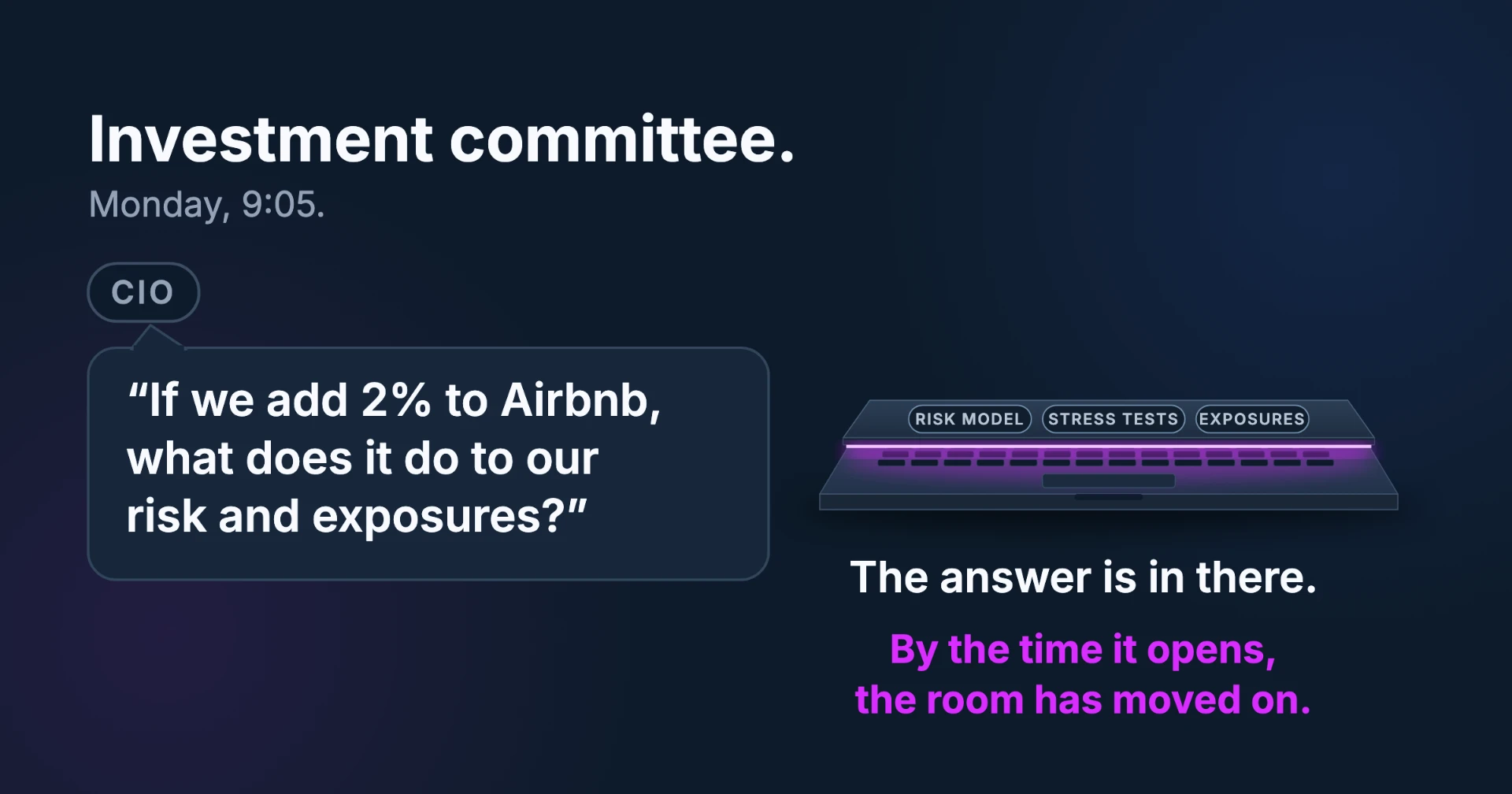
Monday morning, an investment committee sits down. The pack in front of them is sharp: exposures, attribution, a stress run, a full page on the one position everyone is worried about. An analyst built it the night before, and this time the analyst had real help. A conversational risk tool answered questions in plain English. An agent pulled the numbers from four systems with no exports. The pack is better than it was two years ago.
Then the CIO asks the question that is not in the pack. "What if we add 2% to Airbnb? Where does that put our concentration, and what does it do to the sleeve's vol budget?"
The laptop with all that AI on it is closed. The answer comes from someone's memory, or it comes back tomorrow, in the next pack, after the decision is already made.
That is the state of AI in investing right now. It is very good at the desk. Decisions get made somewhere else. The next move is an answer in the room, while the committee is still deciding.
The desk already has AI
Conversational risk Q&A has shipped across the incumbents since late 2025. MSCI, Axioma, FactSet, Clearwater and Aladdin take a risk question in plain English and return exposures and a factor decomposition; Bloomberg is rolling it out. Agentic access is arriving on top, so a system fetches the numbers instead of an analyst exporting them by hand. This is real, and it is table stakes. Anyone still selling it as an edge is a year late.
All of it lives in one place: the analyst's desk, typed, ahead of time. It makes the pack faster and deeper. It does nothing for the moment the pack gets used.
Decisions get made in the room
The investment committee meets and the questions come fast, live, in the room. They are terse and lean on shared shorthand: our semis, the China book, the name that gapped on earnings. Everyone there knows what those words mean because they wrote the definitions together. Nobody is typing.
The largest firms can put a person in that room. A risk manager who holds the whole book in their head and answers "what does that cost us" while the discussion is still open. A boutique does not have that person. The question gets parked, and parked questions get settled on instinct and a number that arrives too late to change anyone's mind.
The desk version cannot just walk into the room
Moving an answer from the desk to the committee is not the same product with a microphone bolted on.
It has to speak the team's own terms. In the room, "our semis" is the house definition, the one the team argued its way to. A tool that answers in GICS is answering a different question from the one that was asked.
Speed changes too. A committee will wait ten seconds for a number, but a report that lands tomorrow is too late to change the vote. The hard problem behind the room is latency.
And the answer has to survive scrutiny afterward: the question, the data it used, the number, all replayable later. In a room where money moves, an answer nobody can check is worse than none.
It must never decide. It puts the delta on the table and stops. The committee decides. An agent that recommends the trade has quietly taken a seat nobody offered it.
I have been in that room
I sat on the investment committee of a multi-strategy fund, looking after its risk. The questions that mattered came live, in the meeting, not in a document the night before. Someone would ask what a change did to the book, and the answer was worth most while the discussion was still open. Some I could answer there; the rest waited until I was back at the desk. The job was to be there, in the moment, with the book in my head and the right caveat ready. That presence was the product, more than any single model sitting behind it.
The tools then were a risk model, a stress framework, and a lot of manual work to keep them honest when the regime moved. The presence problem has not changed since. Putting an AI agent on the desk does not solve it. The agent is in the same place the old tools were, one room away from the decision.
The edge is at the decision, not the desk
For a decade the race in quant was a better model and more data. Both are close to commoditized now. The next edge is harder to copy: put the answer where the decision is, in the team's own language, fast enough to change the decision rather than document it.
For a lean team this matters most. You will not outspend the largest funds on risk infrastructure or staff a twenty-person bench behind the committee. You do not have to. You have to make the risk view show up in the meeting and in your terms, in time to matter.
The next chapter of AI in investing is a voice at the table: one that knows your book, answers in seconds, stays on the record, and leaves the call to you. Not a smarter analyst at the desk.
That is the room we are building toward at Medusa. If you sit on an investment committee and have a view on what belongs in that room, I would like to hear it.
Related reading
Get the next essay in your inbox
One or two essays a month on AI and investing, written from inside the industry. No product spam.
Medusa is the AI-native operating system for lean investment teams, built on your stack. The ideas in these essays run in production there.
Watch the Risk Agent demo →