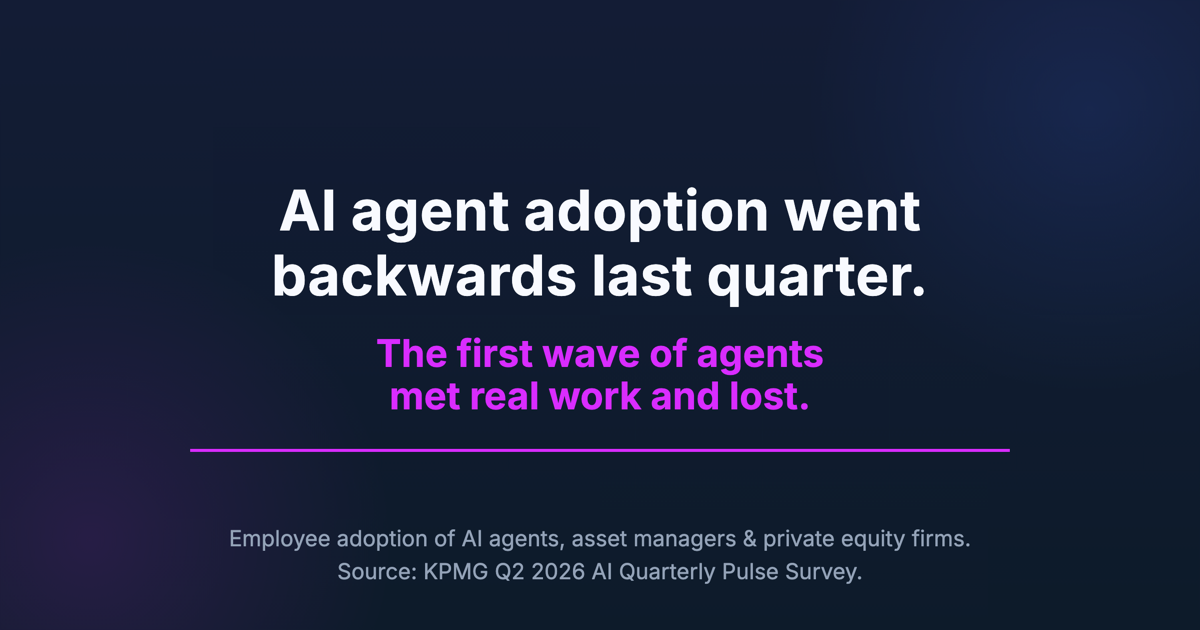
For three years, every AI adoption chart in asset management pointed the same way. This summer, one pointed the other way. KPMG's Q2 2026 AI Quarterly Pulse Survey found that employee adoption of AI agents at asset managers and private equity firms fell to 22% last quarter, from 37% the quarter before. KPMG's companion all-industry pulse, run the same quarter, fell from 55% to 43%. Fifteen points in a quarter, in a direction nobody's roadmap has a box for.
I think it is the most useful number this industry has produced all year.
Most firms have run an AI pilot by now, and most pilots work. The demo lands, access rolls out, the town hall happens. Then comes the stretch nobody budgets for. I call it the second mile: the distance between a working pilot and a system a team relies on daily. The first mile is cheap and it demos well. The second mile is where agents meet real work, real data, and people who have the option of ignoring them. The KPMG drop is the first hard number I have seen for what happens on that stretch.
The generous reading of the drop is a pause before the next wave. The evidence reads more like the morning after the pilot: the first wave of agents met real work and lost.
What fell was use, and use is the honest metric
KPMG fielded the survey from 4 May to 2 June 2026 across 100 US senior leaders at firms with more than $1bn in annual revenue; the figures above are the asset management and private equity cut. The metric is employee adoption: the share of staff actually using AI agents in their work.
The definition matters more than the drop. Budgets and deployments respond to strategy decks. Use responds to whether the thing helped on Tuesday. More than a third of respondents also report staff resistance, which is what "it did not help on Tuesday" looks like in survey form.
Resist reading this as a buy-side pathology. The all-industry figure fell too, from 55% to 43%. The whole first wave of agents hit the same stretch of road at the same time.
The picture an agent answers from
The same KPMG survey asked what blocks deployment. Asset managers and private equity firms ranked data readiness and access first, at 57%. A separate instrument, fielded earlier in the year, returned the same diagnosis: Mercer's 2026 AI in Asset Management survey, run in February across 131 asset managers, found 69% naming data quality or access as a barrier. Two surveys, two populations, two fieldwork windows, and the respondents' own words both times.
One survey cannot prove that the data problem caused the adoption drop, and I will not pretend it can. The mechanism is simple: the PM asks the agent for net exposure, the number disagrees with the risk pack, and nobody asks a third time. The first wrong number costs it credibility. The second costs it the desk. Nobody files a ticket.
I spent seven years running risk and quantitative research across a multi-strategy platform, with Bloomberg PORT, Axioma, an internal PMS and the fund administrator's records live at once. Pulling a number out of any one of them was easy. Getting them to agree was the actual job: different identifiers, different classifications, sometimes a different position altogether. An agent dropped on top of that stack inherits every one of those disagreements, invisibly, and repeats them at conversational speed.
The trust bar is written down now
Two separately dated snapshots put numbers on trust this year.
Mercer's February fieldwork found 5% of asset managers granting AI autonomous or semi-autonomous decision-making authority for investment recommendations or trades.
Then in June, Bridgewater's AIA Labs and Thinking Machines Lab published joint research testing frontier models on six real investment judgment tasks defined by Bridgewater's own investors. The models averaged about 50% accuracy. With expert-written and automatically optimised prompts, none cleared 80%. And 80% was the threshold the investors themselves set before they would trust the system daily.
Scope that result honestly: six models, private tasks, a company research post rather than a neutral benchmark, and research tasks rather than investment risk work. It still tells you where the bar sits, and that nothing off the shelf clears it yet.
The desk arithmetic underneath is simple. An agent hands you an exposure number thirty seconds before you walk into a meeting. You either trust it or you check it, and if checking costs more than looking it up yourself, the agent carries negative value that day. Multiply by every answer, every desk, and you get a curve that looks a lot like KPMG's. The 5% is often read as institutional conservatism. Next to the Bridgewater result, it reads as calibration.
Adoption is won when the checking stops
Every new risk model, stress framework or report won the desk the same way: a PM checked its number against their own, it held, and after a while the checking stopped and the relying began. No rollout plan shortcuts that sequence. No model release does either. Agents get no exemption from that test.
Two consequences follow.
First, verifiability decides adoption. The checking only stops if it is cheap: an answer that traces to the position, the source file and the timestamp can be verified in seconds. An answer that traces to nothing gets one polite look.
Second, measurement. Mercer's survey found 8% of asset managers reporting a measurable improvement in returns from AI. Read carefully, that is partly a value failure and partly an instrumentation failure: most deployments were never instrumented, so when someone finally asks what the pilot changed, nobody defined the metric before it started and nobody can reconstruct it after. If you want to know whether a rollout stuck, count the PMs who used it this week. That number sits in every firm's logs and almost no firm's board pack.
The largest firms bought their way across
The firms that have crossed the second mile paved it with headcount. Balyasny's published case study with OpenAI describes a centralized Applied AI team of 20 researchers, engineers, and domain experts, built from late 2022, with roughly 95% of its investment teams using the internal AI research system just over three years on. The stated reason for building rather than buying is the honest part: the tools on the market did not handle structured and unstructured data together, did not orchestrate workflow, and did not meet their compliance standards.
That is the price of the second mile when you pave it yourself: a 20-person team and more than three years. A $400M fund will never field that team, and that asymmetry is worth watching for the rest of the decade. The capability gap between the two ends of this industry is currently a headcount gap. Headcount does not trickle down.
What survives the second mile
None of this puts the direction in doubt. In the same February and March fieldwork, 91% of Mercer's asset managers planned to increase AI use within twelve months. The drop is a correction in use sitting on top of broad, durable intent. Nearly everyone will attempt the second mile. Few will cross it.
A pilot design that survives it, built from the evidence above:
- Pick one workflow with a clock on it. Time to answer the exposure question before the Monday meeting is measurable. "Productivity" is a wish.
- Write the success metric before the pilot starts. Mercer's 8% is what happens when nobody does.
- Make every answer traceable to the position, the file and the timestamp, so the hand-checks that build trust cost seconds instead of an afternoon.
- Judge the pilot on weekly use by the people who make decisions, measured from the logs. It will not measure itself.
So what for your week: if your firm rolled out agents in H1, the honest review question is which of these four the rollout would have passed. The KPMG number suggests the first wave mostly skipped them.
And the category question underneath it all. The first wave measured access and called it adoption. The charts will turn up again. The firms that cross will be the ones measuring use. Which number is on your firm's chart?
Related reading
Get the next essay in your inbox
One or two essays a month on AI and investing, written from inside the industry. No product spam.
Medusa is the AI-native operating system for lean investment teams, built on your stack. The ideas in these essays run in production there.
Watch the Risk Agent demo →